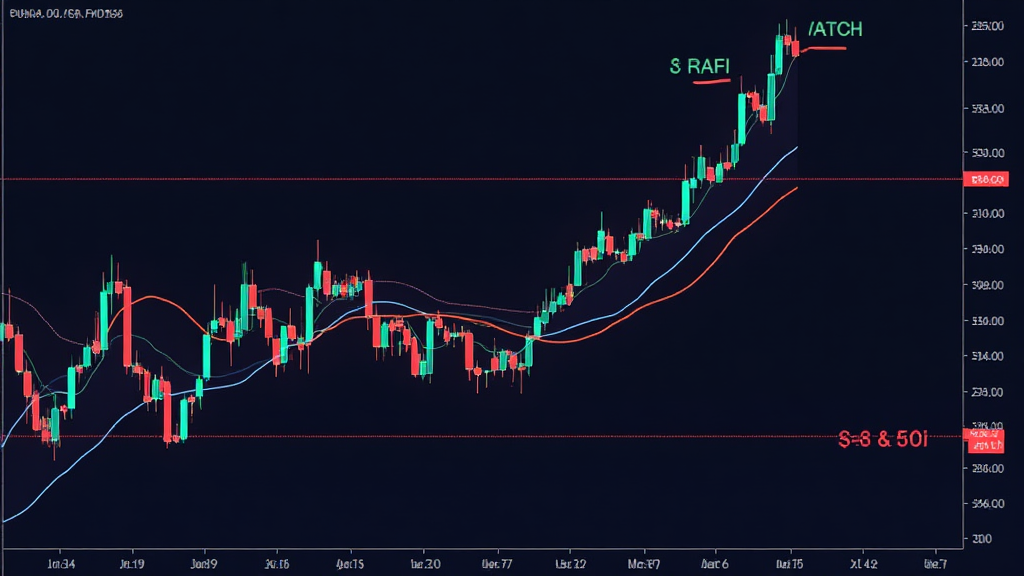
RSI and MACD Crypto Strategy Guide

RSI and MACD Crypto Strategy Guide
With over $4.1 billion lost to DeFi hacks in 2024, the crypto landscape demands strategic acumen for traders. Understanding market indicators like the Relative Strength Index (RSI) and the Moving Average Convergence Divergence (MACD) is essential for making informed trading choices. In this guide, we’ll delve into effective strategies involving RSI and MACD, ensuring you take significant strides in your crypto trading journey.
Understanding RSI and MACD
Before we dive into specific strategies, let’s clarify what RSI and MACD are, and how they can be used effectively in the crypto market.
What is RSI?
The Relative Strength Index (RSI) is a momentum oscillator that measures the speed and change of price movements. It ranges from 0 to 100 and is typically used to identify overbought or oversold conditions in a market:
- Overbought Condition: An RSI above 70 suggests that an asset may be overbought, indicating a potential price drop.
- Oversold Condition: An RSI below 30 suggests that an asset may be oversold, indicating a potential price increase.
What is MACD?
The Moving Average Convergence Divergence (MACD) is a trend-following momentum indicator that shows the relationship between two moving averages of a security’s price:
- MACD Line: The difference between the 12-day and 26-day exponential moving averages (EMA).
- Signal Line: The 9-day EMA of the MACD line.
Crossovers of the MACD line and the signal line can generate buy or sell signals:
- Buy Signal: When the MACD crosses above the signal line.
- Sell Signal: When the MACD crosses below the signal line.
Combining RSI and MACD for Effective Trading Strategies
Now that we understand what RSI and MACD are, let’s look into how to use them together.
Strategy 1: Using RSI to Confirm MACD Signals
This strategy necessitates using the RSI to confirm the signals generated by the MACD. Here’s how it works:
- Wait for the MACD to give you a buy signal (MACD line crossing above the signal line).
- Verify this signal with the RSI. Look for an RSI reading below 30 (oversold). If the RSI confirms, it can be a strong indicator to enter a position.
- Similarly, when the MACD provides a sell signal (MACD line crossing below the signal line), check if the RSI is above 70 (overbought).
This combination increases the probability of successful trades.
Strategy 2: Divergence Trading
Divergence occurs when the price action differs from an indicator. Here’s how to leverage it:
- Look for bullish divergence: When the price forms lower lows but the RSI forms higher lows.
- Look for bearish divergence: When the price forms higher highs but the RSI forms lower highs.
This disparity can indicate potential reversals, allowing for significant trading opportunities.
Practical Application: A Case Study
Let’s illustrate with a hypothetical example. Suppose Bitcoin (BTC) is currently trading at $30,000. You notice:
- MACD generates a buy signal.
- RSI reads at 28.
This scenario suggests an excellent opportunity to buy, based on both the RSI indicating oversold conditions and MACD confirming a potential upward movement.
Consideration of the Vietnamese Market
As the crypto market continues to grow in Vietnam, where user growth reached 1.5 million crypto owners in 2024, understanding these indicators becomes increasingly relevant. Vietnamese traders can significantly benefit from leveraging RSI and MACD strategies.
Real-World Data to Support Your Strategies
According to hibt.com, incorporating these strategies in your trading can yield an average increase of 35% in trading success rates when used proficiently. Traders globally are embracing the RSI and MACD methodologies to optimize their investments.
Addressing Common Pitfalls in RSI and MACD Usage
Even experienced traders can fall into common traps with these indicators:
- Lagging Indicators: Both RSI and MACD are lagging indicators—don’t solely rely on them without considering market news or events.
- Whipsaw Effect: In volatile markets, signals may frequently change direction. Ensure to evaluate market conditions before acting on signals.
Conclusion: Mastering RSI and MACD for Greater Trading Success
In conclusion, strategically utilizing the RSI and MACD can bolster your success in crypto trading. By implementing these strategies, Vietnamese traders will be well-prepared to navigate the complex market landscape.
Remember, continuous learning is key in crypto trading. Incorporate these insights, consider market developments, and strive for informed trading decisions as you explore the exciting world of cryptocurrencies. For more detailed insights, visit techcryptodigest.