Understanding Blockchain Consensus Mechanism: A Detailed Guide

Understanding Blockchain Consensus Mechanism: A Detailed Guide
In the rapidly evolving world of cryptocurrency, blockchain consensus mechanisms play a critical role in maintaining the security and integrity of digital transactions. With cybersecurity breaches leading to over $4.1 billion lost to DeFi hacks in 2024, understanding these mechanisms is essential for protecting digital assets and ensuring trust within the blockchain ecosystem.
What is a Blockchain Consensus Mechanism?
A blockchain consensus mechanism is a foundational protocol that enables nodes to agree on the state of the blockchain. It ensures that every transaction is valid and acknowledged by participants, thus maintaining a synchronized and trustworthy ledger. By ensuring that all parties have the same information, it eliminates the risk of fraud, double-spending, and attacks on the network.
Importance of Consensus Mechanisms
- Security: Consensus mechanisms provide a safeguard against malicious attacks by ensuring that only valid transactions are added to the blockchain.
- Decentralization: They enable the decentralized nature of blockchains, ensuring no single party controls the network.
- Trust: By using these mechanisms, trust is established among participants who may not know or trust each other.
Types of Blockchain Consensus Mechanisms
Different blockchain consensus mechanisms cater to various needs and use cases. Let’s explore some of the most prevalent systems:
Proof of Work (PoW)
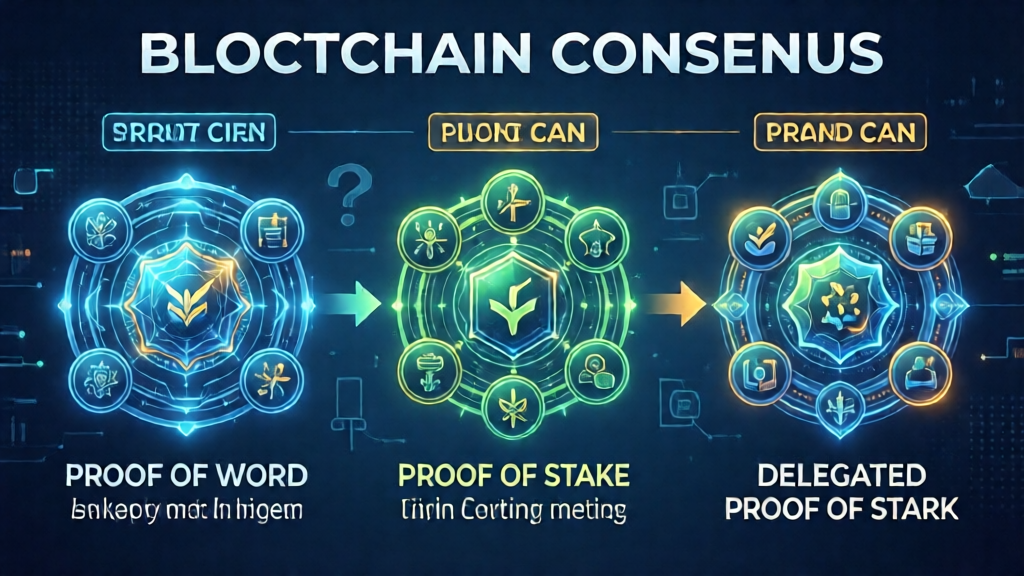
Proof of Work is the traditional consensus mechanism used by Bitcoin. Miners solve complex mathematical problems to validate transactions, ensuring network security at a cost of energy consumption.
- Pros: Highly secure; resistant to attacks.
- Cons: Energy-intensive; slower transaction times.
Proof of Stake (PoS)
Proof of Stake allows participants to validate transactions based on the number of coins they hold. This method significantly reduces energy consumption and transaction validation times.
- Pros: More energy-efficient; faster results.
- Cons: Potential centralization; wealth inequality may lead to less participation.
Delegated Proof of Stake (DPoS)
In DPoS, stakeholders elect a small number of delegates who take responsibility for validating transactions. This provides a democratic approach to consensus.
- Pros: Fast and efficient transactions; increased scalability.
- Cons: Risk of voter apathy; centralization of power among few delegates.
Practical Byzantine Fault Tolerance (PBFT)
PBFT is designed to work efficiently in a permissioned blockchain and can tolerate a certain number of faulty nodes without compromising the system’s integrity.
- Pros: High transaction speed; excellent for enterprise solutions.
- Cons: Limited scalability in public blockchains; requires more nodes to reach consensus.
Challenges and Vulnerabilities in Consensus Mechanisms
While consensus mechanisms are designed to prevent fraud, they are not without their challenges and vulnerabilities. Here are several that deserve attention:
51% Attack
This occurs when a single entity gains majority control over a network’s hashpower, allowing them to manipulate the ledger and potentially double-spend coins.
Sybil Attack
In a Sybil attack, an adversary creates multiple fake identities to gain influence and disrupt the network’s consensus, effectively misleading legitimate users.
Case Study: The Ethereum Transition from PoW to PoS
The much-anticipated transition of Ethereum from Proof of Work to Proof of Stake highlights the evolving strategies in consensus mechanisms. This shift aims to enhance scalability and reduce energy consumption.
According to Chainalysis 2025 report, Ethereum’s shift could reduce its energy consumption by up to 99%, making it one of the most sustainable blockchain platforms.
Future of Blockchain Consensus Mechanisms
Looking ahead, advancements in consensus mechanisms are likely to trigger significant shifts in the crypto landscape. Enhanced mechanisms that incorporate layer-two solutions may achieve faster, more secure transactions whilst maintaining energy efficiency.
Key Trends:
- Hybrid models combining PoW and PoS.
- Increased focus on ecological sustainability.
- Emerging consensus mechanisms catering to specific applications like IoT.
Conclusion
In an industry valued at more than $2 trillion, the blockchain consensus mechanism is fundamental to the continued growth and security of cryptocurrencies. For stakeholders, understanding these mechanisms is not just an academic exercise; it’s essential to safeguarding assets and ensuring confidence in decentralized finance. Whether it’s through PoW, PoS, or emerging models, the long-term viability of these systems will play a crucial role in shaping our digital future.
As we navigate the evolving challenges and opportunities within this sector, platforms such as TechCryptoDigest aim to provide valuable insights and guidance on these complex topics.
Author: John Doe, a blockchain consultant with extensive experience in auditing smart contracts and authoring over 15 papers in the domain. His insights have shaped the protocols of several well-known projects.